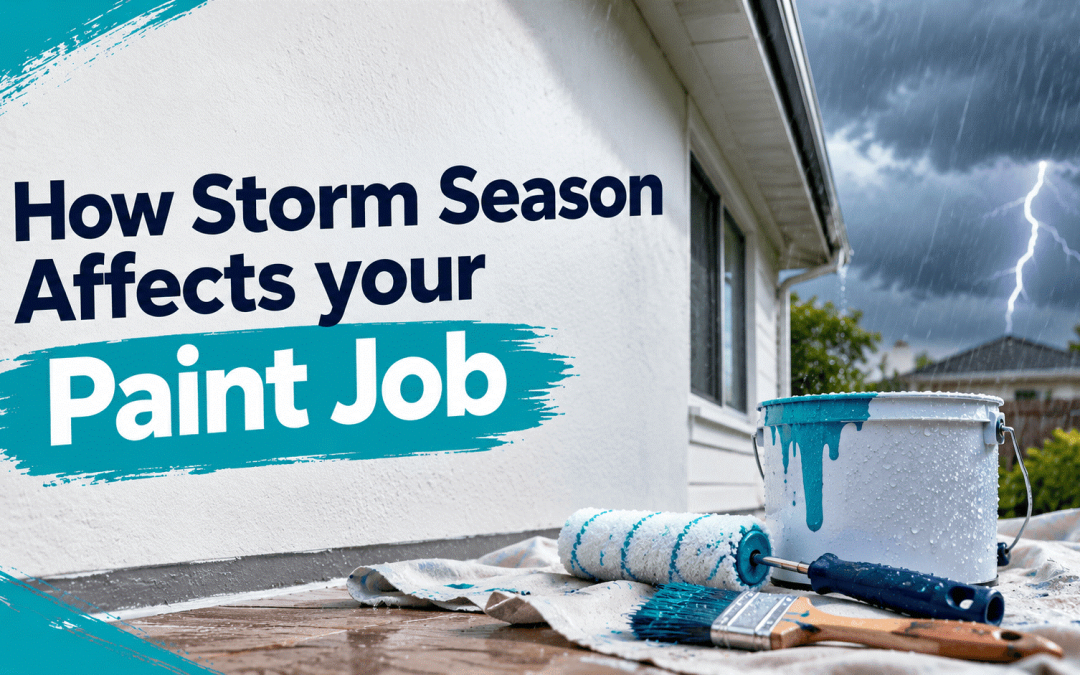
Most homeowners are told that they should avoid storm season when they are about to repaint their houses, but few of them are told the reasons why. Understanding how storm season affects exterior paint involves examining the processes of Brisbane storm season exterior paint damage, and when the risk is real and when it is not.
There is no single problem of storm damage. It is the result of three different failure modes: rain that falls before the coat has cured, rain that has been blown by the wind that has penetrated your eaves and water that penetrates and results in blistering days after the storm has passed. They all occur at various points in the job and require various responses.
When Does the Storm Season in Brisbane Start?
The risk that affects Brisbane storm season exterior paint damage is between about November and April, when hot and humid days accumulate into afternoon thunderstorms. The Brisbane wet season painting risk cuts across a large portion of the year; this post emphasizes the mechanisms as opposed to the calendar. It is better to know the reasons why paint fails rather than evading a date range.
The Real Mechanisms: How Rain and Storms Actually Damage Fresh Paint
All storm damage is not created in a similar manner or at the same stage of a paint job. Some is first-hand, some is stored away till later, and some comes in a place where you thought it was secure. The following are the three failure modes to know.
Washout During Cure: The first 24-48 hours are crucial.
The most common form of rain damage fresh exterior paint suffers is paint washout during cure. The paint, which may be dry to the touch has not always cured. The binder is still forming the tough film beneath the surface which holds the pigment in position.
Water can easily remove pigment and binder from the wall when it is struck by rain before that film forms. The effect is spotty, streaky coverage. Since the film itself is wrecked, it is not a fast make-over. Patches are visible as various sheens or tones through patches, and the section tends to warrant a total redo.
So, does rain spoil new exterior paint? It can very often do so in this window. The time that exterior paint takes to dry before rain is much more important than most homeowners think, and that is why good painters monitor the radar and not just the daily forecast.
Wind-Driven Rain: Why Under the Eaves is Not always so safe.
It is a common belief that walls which bear broad eaves are safe. That is true, to a large extent, in a tender, vertical shower. The storms in Brisbane, however, tend to be near-horizontal and wind driven rain exterior paint damage is one of the most underestimated risks.
Rain blown by the wind runs under eaves, over verandahs and directly on walls that would not otherwise have been moistened. Particularly vulnerable are window frames, fascia and upper wall sections. A house may have the semblance of being safe on paper but be squarely hit on the freshest side.
This is the reason why a good weather window is based on wind direction and storm intensity, rather than whether it rains. When the view is the most settled, a conscientious painter orders the work, so that the exposed elevations are done when the view is calm.
Post-Storm Humidity Swings and Blistering
Certain damage is observed long after the rains have stopped. Post storm blistering of paint occurs where a layer of paint survives the rain but collapses days afterward due to trapped moisture.
Whether the substrate is wet due to the wet season, fresh rainfall or the humidity, it must have a place to drain. The paint surface becomes dry too quickly especially when it is in a hot sun following a storm, and thus it forms a skin. Attempting to escape moisture and blows up the film into bubbles.
The day of humid and stormy weather and good sun that follows later is just the alternation that helps to promote it, in Brisbane. This is also the reason why moisture checks and proper preparation are so important.
How Long Does Exterior Paint Need to Dry Before Rain?
Surface-drying of exterior paint typically occurs in a matter of hours, though the process can require several weeks to complete depending on the product, temperature and humidity. The maximum risk of washouts is during the first 24-48 hours, and in that case, always take the manufacturer’s rain-free precautions when using a product.
The difference is important since being dry to the touch does not imply being safe. The exterior paint cure time before rain is more or less concerned with the way the film hardens rather than the sensation.
Rain-Resistant Paint Technology: A Real Mitigation Option
It is something that most competitor content does not refer to. Newer rain resistant exterior paint formulations are made to resist rain within about 20 minutes of application. The surface film rapidly sets to accommodate a sudden shower within that initial window.
In the case of the afternoon storm pattern in Brisbane that is a significant benefit. It provides more flexibility to crews and eliminates the possibility of a wasted day.
It is well worth being realistic, though. The rain resistant exterior paint is a true mitigation rather than an assurance of all storm risk aversion. Even a harsh storm with heavy rain moving by the wind can do harm and blistering due to the trapped moisture is another problem that the product will not resolve. Use it as an alternative to negotiate at the moment of booking, in addition to timing, preparation, and the forecast.
Not sure if rain-resistant paint suits your home?
Tell us about your house and we’ll recommend the right product and
timing for Brisbane’s storm season.
What to Do When it Rains on Fresh Coat.
In case rain damage fresh exterior paint is of concern to you, there is no cause to panic and then start scrubbing. The first thing is to determine when it started to rain. During the cure window, the most likely scenario to be actually damaging is rain within the first day or two. Several days later, a rain can hardly result in a washout.
Next, look closely. Washout presents itself in the form of streaks, runs, thin patches, or uneven colour. Dulling of the surface is a slight, temporary alteration of sheen and normally settles as the paint is cured, and water spotting tends to fade.
After the entire surface is completely dry, take pictures of the affected areas and compare them with areas that are not affected. Wait-and-see approach is acceptable in case changes are minor and even. Should there be heavy streaking, loss of pigment or bubbles due to post storm paint blistering, then call in a professional reassessment early, as delays may complicate the repair. Do not do self-repainting with wet or freshly damaged paint.
You are waiting on the weather, but you might think of indoor work. Our Interior House Painting Brisbane service is unaffected by storm season and keeps your project moving.
Rain hit your fresh paint?
Send us a few photos and we’ll tell you whether it’s washout or normal
dulling, and whether it needs a repair.
Warranty/Insurance considerations and Storm Damage
The timing has an impact beyond the finish. The issue of storm damage exterior paint insurance normally depends on whether the coating was dry or not. The destruction of a job in the course of curing will not be in the same case as the destruction of an established coat in a single storm.
In the case of an exterior paint warranty storm damage claim, the question is usually whether the job was performed reasonably taking into consideration the weather and product specifications. In the case of insurance, it may be determined based on the damage being caused by the storm or by a coating that had not yet dried. The specifications depend on the provider and policy.
This is not legal or insurance advice; it is general information. In case you will have to claim, read your policy, take dated photos, and talk to your insurer and painter as early as possible.
Frequently Asked Questions
Will new exterior paint be ruined by rain?
It can not always. Pigment and binder can be washed away during the 24 to 48 hours before the paint is dry, and the pigment can provide patchy coverage. After that window, light rain will be less likely to do any serious damage.
How long before exterior paint is rain-safe?
Surface-dry Most exterior paint becomes fully cured in 2-4 weeks, but is surface-dry in a few hours. Rainproof formulas are able to manage the rain within approximately 20 minutes; however, never neglect the guidelines of the product.
What happens if it rains right after painting?
Streaks, or runs, or patchy colour may also be evident, unless the paint has set. Light dulling will set as it dries, but deep washout generally requires sanding and reheating.
Is storm damage to fresh paint covered by insurance?
It is based on your policy and whether the paint was dry during the time of damage. Time can influence the way a claim is evaluated, so consult your policy and discuss with your insurance company.
Conclusion
Damage in the storm is not just a single risk, but a multiplicity of risks: the paint washout during the cure, the wind may blow the rain over your eaves, and the moisture may be stuck in the blisters, causing the blisters to take ages to heal. Every one of these hits at a different point of the work, so that one rule, such as, just keep out of the wet season, will never give the whole of the story. The time of the cure window is more important than most homeowners understand, and having rain resistant exterior paint is an actual possibility that can be discussed before the work commences. The knowledge of storm season influence on exterior paint places you in a better position to manage Brisbane storm season exterior paint damage even before it occurs.
The lesson of the day is that planning is good, not luck. Ask your painter how they keep track of the forecast, how they arrange the elevations, which are exposed to the direction of the prevailing storm, and how they test to be sure that the substrate is thoroughly dry before commencing the first coat. Enquire about the rain-free time of the product they would like to use, and whether it would be wise to have a quicker setting formulation in your home. These questions occupy a couple of minutes, but they draw the line between a lasting finish and one that burns, blisters or requires a complete re-write.
Lastly, a good painter will not lie about the risk but will tell you that something will not happen in a certain circumstance. That truthfulness, coupled with judicious timing and proper paint, is the greatest safeguard your investment will have.
Willing to make plans around the weather? Order Now and we can assist you in deciding on the appropriate time and products to use in the conditions of Brisbane.
Plan your repaint around the weather, not the guesswork.
Painting by Moli schedules Brisbane exterior jobs around the forecast,
wind direction, and cure times.
QBCC licensed · Brisbane painters